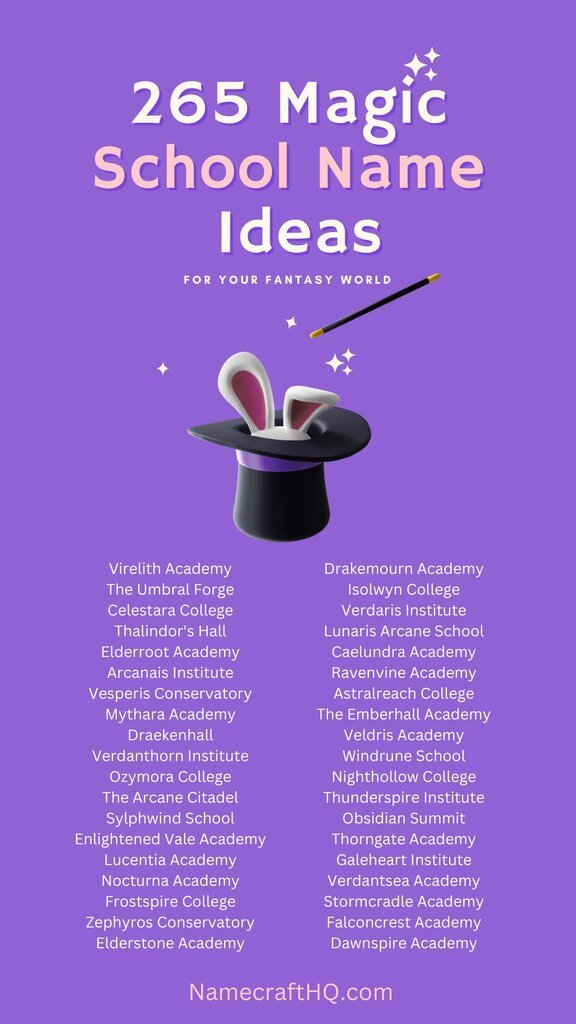
Naming a magic school isn't just about picking a cool-sounding word; it's about integrating your magic school name with lore and worldbuilding so deeply that the institution itself becomes a living part of your fantasy world. A well-chosen name doesn't just label a place; it whispers its history, hints at its magical focus, and embeds it within the very fabric of your story. Forget generic academies—your school's name should be a shortcut to understanding its soul, instantly signaling its purpose, prestige, or even its perils to anyone who hears it.
At a Glance: Crafting a World-Deep Magic School Name
- Evoke Emotion & Mystery: Choose words that spark imagination and hint at magical qualities.
- Root in History: Reflect your world's ancient languages, founders, or key events.
- Show, Don't Just Tell: Let the name hint at the school's magical focus, culture, or location.
- Sound Memorable: Opt for unique phonetics that are pleasing to the ear and easy to recall.
- Align with Lore: Ensure the name reflects your world's unique cultural context and magical values.
- Avoid Generic Labels: Steer clear of bland descriptors that don't add depth.
- Test for Resonance: Say the name aloud, write it down, and see how it feels within your world.
Beyond the Gates: Why Your Magic School's Name Truly Matters
Think of Hogwarts, Brakebills, or Unseen University. These aren't just labels; they're immediate cultural touchstones. Each name instantly conjures images, traditions, and a distinct magical atmosphere. Your magic school's name holds similar power for your world. It's often the first glimpse your audience gets into a cornerstone of your magical society—a place where heroes are forged, ancient secrets are guarded, or forbidden arts are secretly practiced.
A truly impactful name does more than identify; it sets expectations. It can hint at the school's age, its philosophical leanings, its dominant magical discipline, or even its geographical peculiarities. Without a name that resonates with your lore, your institution risks feeling like a generic "school of magic" rather than a unique, world-defining entity. It's the difference between a place that merely exists and one that feels real and consequential.
The Foundations of a Fabled Name: What Makes It Stick?
Crafting a name that endures requires a thoughtful approach, combining elements that speak to both the ear and the imagination. You’re building an identity, not just a label.
Evocative Language: Sparking the Imagination
The best magic school names don't just state; they suggest. They use words that hint at mystery, power, or ancient secrets. Consider words that evoke magical phenomena, natural forces, or even abstract concepts like knowledge and wisdom. "Grimoire Academy" immediately suggests a focus on ancient texts and traditions, while "Whisperwind School" implies a lighter touch, perhaps elemental harmony or stealthy magic.
Historical Resonance: A Nod to the Past
A name deeply rooted in your world's history lends immediate gravitas. This could stem from ancient languages, referencing a legendary founder, or commemorating a pivotal event. For instance, "Thalindor’s Hall" suggests an ancient figure whose legacy defines the institution, possibly specializing in forgotten spells. Researching real-world etymology or crafting a simple fictional language can provide a rich source of authentic-sounding components.
Magical Elements: Defining the Focus
What kind of magic is taught here? The name can be a powerful indicator. "Virelith Academy" might imply elemental manipulation, while "Celestara College" clearly points to astral and celestial magic. By embedding specific magical concepts—creatures, phenomena, or disciplines—you give your audience an instant understanding of the school's core curriculum and its students' potential.
Unique Phonetics: Sounding the Part
A memorable name often rolls off the tongue. Pay attention to how the name sounds when spoken aloud. Is it melodious, imposing, mysterious, or perhaps a little whimsical? The flow and rhythm of the syllables contribute significantly to its memorability. "Draekenhall" sounds strong and ancient, fitting for a school focused on dragonology, whereas "Sylphwind School" feels light and agile, perfect for air and wind magic. Don't be afraid to experiment with combining words or creating entirely new ones to achieve that unique phonetic quality. If you're struggling to brainstorm, remember you can always generate magic school names for a spark of inspiration.
Cultural Context: Reflecting World Values
Your magic school doesn't exist in a vacuum. Its name should reflect the prevailing culture, values, and even the societal structure of your fantasy world. Is magic revered, feared, or strictly regulated? "The Arcane Citadel" suggests an elite, perhaps exclusive institution focused on advanced magic, implying a world where such power commands respect and perhaps even fear. Conversely, "Enlightened Vale Academy" hints at a community-oriented approach, blending magic with wisdom. The name can communicate whether the institution is open or secretive, traditional or progressive, benign or ominous.
Weaving the Threads: Integrating the Name with Your World's Tapestry
Once you have a name that feels right, the real magic begins: seamlessly integrating it into every facet of your lore and worldbuilding. This isn't about slapping a label on a building; it's about making the name an organic extension of your world's history, geography, and magical philosophy.
Historical Roots: A Name Born of Legend
Every institution has a past, and your school's name can tell a significant part of that story.
- Founding Figures: Is your school named after a legendary mage who established it? "Thalindor’s Hall" or "Elderroot Academy" immediately suggests a revered founder whose specific magical leanings (ancient magics, nature magic) shaped the institution.
- Pivotal Events: Did the school rise from the ashes of a war, a magical cataclysm, or a groundbreaking discovery? A name like "Stormcradle Academy" could hint at its origin in a tempestuous region or its foundation after a significant weather event, forever linking it to the manipulation of storms.
- Ancient Lineages: Perhaps the name traces back to an ancient magical lineage or a forgotten civilization, like "Ozymora College," which suggests a focus on forgotten arcane languages, hinting at deep scholarly roots.
Cultural Resonance: A Reflection of Society
The name of your magic school can subtly (or overtly) communicate your world's cultural norms and magical philosophies.
- Societal Role: Is it a bastion of knowledge, a secretive guild, or a public institution? "The Arcane Citadel" speaks to exclusivity and advanced studies, perhaps for an elite class, while a name like magic academy names that are more common might suggest broader access to magical education.
- Magical Philosophy: Does your world embrace all magic, or are certain branches taboo? "The Umbral Forge" explicitly signals a focus on shadow magic and dark arts, which might be tolerated, feared, or revered depending on your world's moral landscape. Conversely, "Luminous Crescent Academy" points to light-based magic and positive energy, perhaps in a society that values purity and healing.
- Tradition vs. Innovation: Names can indicate a school's adherence to old ways or its pursuit of new magical frontiers. "Grimoire Academy" leans heavily into tradition and established magical texts, whereas "Riftweaver Academy" suggests exploration of new, perhaps dangerous, dimensional magic.
Geographical Connection: A Place Shaped by Its Surroundings
The physical location of your magic school can be intrinsically linked to its name, giving it a tangible presence in your world.
- Landscape Features: Is it nestled in a valley, perched atop a mountain, or hidden within a forest? "Elderstone Academy" evokes ancient, earth-drawing magic and suggests a location rich in geological power. "Frostspire College" clearly places itself in a cold, mountainous region, focusing on ice and cold magic.
- Resource Availability: Does the school draw its power or teachings from local resources? "Verdaris Institute" directly references forest magic, trees, and plants, implying a deep connection to a verdant environment.
- Mystical Locations: Perhaps the school is built on a site of significant magical energy. "Astralreach College" might be situated in a place known for celestial observations or cosmic energy conduits, enabling its focus on star and space magic. Even whimsical names like "Puddlejumper Academy" could reflect a unique watery locale or a magical phenomenon specific to its surroundings.
Magical Focus: What They Teach (and How They Teach It)
Perhaps the most direct way a name integrates with lore is by revealing the school's primary magical disciplines or its unique teaching methodology.
- Specialized Disciplines: "Draekenhall" makes its focus on dragonology undeniable. "Vesperis Conservatory" highlights moon magic, while "Mythara Academy" specifies mythological creatures and beast magic. These names tell prospective students (and your audience) exactly what kind of education to expect.
- Combined Disciplines: Some schools might blend different magical types, reflected in their names. "Frostfire Conservatory" instantly communicates a balance of opposing ice and fire elements. "Verdanthorn Institute" suggests a harmonious blend of natural magic with traditional spellcasting.
- Unique Methodologies: Does the school approach magic differently? "The Madcap School of Sorcery" might indicate a less conventional, more whimsical form of spellcasting, or a unique, less structured teaching style. If you're building a world with a distinct magical education system, choosing wizarding school names that reflect their pedagogical approach is key.
Linguistic Depth: The Power of Hidden Meanings
A name can hold layers of meaning, enriching your lore with every discovery.
- Ancient Tongues: Incorporating fragments of an ancient, in-world language into your school's name can add immense depth. For example, a root word meaning "star" or "wisdom" in your fictional language could be woven into "Astralreach" or "Enlightened Vale."
- Symbolism: Elements of your name can symbolize core tenets or mysteries of your world. "Obsidian Summit" could symbolize both the unyielding nature of earth magic and the dark, hidden depths of magical artifacts and enchanted objects studied there.
- Prophetic Echoes: A name might even subtly allude to a prophecy or a destined role the institution plays in your world’s future, adding an intriguing layer of foreshadowing.
Brainstorming Themes: Igniting Your Imagination
Drawing inspiration from broad themes can help you narrow down the perfect components for your school's name. The ground truth provides excellent starting points:
- Nature and Elements: "Elderroot Academy" (nature), "Virelith Academy" (elements), "Frostspire College" (ice), "The Emberhall Academy" (fire). Names like "Verdant Leaf University" or "Aquarius Institute" clearly define their connection to natural forces.
- Celestial Bodies: "Celestara College" (astral/celestial), "Vesperis Conservatory" (moon), "Astralreach College" (star/space). Consider "Lunarium College" for moon magic or "Nebula Academy" for cosmic manipulation. These names evoke a sense of grandeur and connection to the cosmos.
- Mythological Figures: "Mythara Academy" (mythological creatures). While not directly named after a figure, the spirit of mythology can inspire, like a school named after a legendary hero of your world.
- Magical Artifacts: "Obsidian Summit" (magical artifacts). A school might be named after a powerful relic it guards or a type of artifact it specializes in creating, like "Glimmerforge Academy" for enchanting and crafting.
- Founders or Famous Mages: "Thalindor’s Hall." Naming a school after its founder gives it immediate lineage and legacy.
- Magical Locations: "The Arcane Citadel," "Enlightened Vale Academy." The name can literally be derived from its setting, grounding it geographically.
Beyond these, consider the darker side: - Forbidden Arts: "The Umbral Forge" (shadow/dark arts), "Nocturna Academy" (darkness/necromancy), "Blightwood School" (darker arts, curses). These names carry an air of danger and forbidden knowledge, crucial for worlds where magic isn't always benevolent.
- Destruction & Chaos: "Shatterstone College" (destruction), "Brimstone College" (destructive fire/explosive spells). Such names signal a school that teaches potent, often dangerous, magic.
- Secrets & Illusion: "Shadowmere Institute of Arcane Arts" (shadow/illusions), "Miragefall Institute" (illusion magic). These suggest schools for subterfuge and hidden knowledge. If you're exploring the more mysterious aspects of magic, names like witchcraft school names can often evoke a sense of ancient, hidden practices.
Pitfalls to Avoid: Don't Let Your Name Fall Flat
Even with the best intentions, it's easy to stumble. Keep these common mistakes in mind as you integrate your school's name.
- Being Too Generic: "The Magic School" or "Academy of Magic" tells us nothing. These names lack the unique character and depth needed to anchor an institution in a rich fantasy world. Strive for specificity.
- Conflicting with Lore: A name like "Sunstone Academy" for a school specializing in necromancy creates dissonance. Ensure your name aligns with your world's established magical rules, cultural values, and the school's actual purpose.
- Unpronounceable or Unmemorable: If readers can't easily say or recall the name, it won't stick. While unique phonetics are good, overly complex or tongue-twisting names can hinder immersion. Test your names by saying them aloud several times.
- Accidental Comedy: Be careful with unintended meanings or associations. What sounds grand to you might sound silly to someone else. Get feedback if you're unsure.
- Lack of Foresight: Will the name still make sense if your world or the school's focus evolves? A name too narrowly defined might limit future story arcs. "Frostfire Conservatory" works because it represents a balance, allowing for diverse teaching.
- Overly Long or Clunky: While some institutions might have longer, formal titles, a common, easily referenced name is usually preferred. Think about how characters would actually refer to it in dialogue.
Practical Steps to Weave It All Together
Integrating your magic school's name is an iterative process. It's not a one-and-done task but a continuous refinement as your world takes shape.
- Define the Core: Before naming, thoroughly understand your school's essence:
- What's its primary magical focus? (e.g., elemental, arcane, dark, nature)
- Who founded it, and when? What's its historical significance?
- Where is it located, and what are its physical characteristics?
- What is its reputation in the world? (e.g., prestigious, notorious, hidden)
- What values does it represent?
- Brainstorm Keywords & Concepts: Based on your core definition, list evocative words related to:
- Magic types (e.g., "Arcane," "Umbral," "Celestara," "Vesperis," "Inferno")
- Places/Geography (e.g., "Spire," "Forge," "Vale," "Citadel," "Reach," "Summit," "Glade")
- Historical terms (e.g., "Elder," "Ancient," "Grimoire," "Hall")
- Founders' names or titles (e.g., "Thalindor," "Elderroot")
- Adjectives that describe its character (e.g., "Whisperwind," "Enlightened," "Madcap")
- Mix & Match: Start combining these keywords. Don't be afraid to experiment with different structures:
- Adjective + Noun (e.g., "Whisperwind School")
- Founder's Name + Institution Type (e.g., "Thalindor’s Hall")
- Concept + Location (e.g., "The Umbral Forge," "Arcane Citadel")
- Compound Words (e.g., "Frostspire," "Emberhall")
- Refine & Test:
- Say it aloud: Does it sound good? Is it easy to pronounce?
- Write it down: How does it look on the page?
- Check for conflicts: Does it clash with other names in your world? Does it accidentally sound like a real-world entity?
- Gather feedback: Ask trusted readers for their initial impressions. Does the name convey what you intend? This is especially helpful if you're aiming for a specific feel, like with Harry Potter-style magic school names which often have a whimsical yet classic tone.
- Embed in Lore: Once you've chosen your name, actively seek opportunities to weave it into your worldbuilding:
- Origin Story: Detail how the school got its name. Was it named by its founder, after a significant event, or due to a natural feature?
- Architecture: Does the school's architecture reflect its name? "Frostspire College" might literally feature spires of ice or crystal. "Elderroot Academy" could be built around ancient trees.
- Curriculum: Ensure the courses offered and the magical disciplines taught align with the name's implications.
- Student Culture: Does the student body or faculty's personality match the name's vibe? Are "The Madcap School of Sorcery" students known for their unconventional methods?
- In-World References: Have characters refer to the school by its full name, nicknames, or even derogatory terms derived from its name, further deepening its presence.
Mini Case Snippets: Names in Action
Let's look at how some of the provided examples effortlessly integrate their names with their focus:
- Virelith Academy (Elemental manipulation): "Virelith" is an invented word, but its hard "V" and "th" sounds give it an ancient, almost earthy feel, subtly hinting at fundamental forces. Its focus on elemental magic reinforces this grounded, powerful impression.
- The Umbral Forge (Shadow magic and dark arts): "Umbral" directly means shadow or darkness. "Forge" implies creation, shaping, and intense heat, suggesting a place where dark arts are actively crafted and honed, rather than just studied passively. The name instantly tells you this isn't a place for light-hearted magic.
- Celestara College (Astral and celestial magic): "Celestara" clearly derives from "celestial" or "star." The addition of "College" suggests a higher learning institution, perfectly aligning with its focus on the grand, cosmic energies of the astral plane.
- Elderroot Academy (Nature magic and druidic ways): "Elderroot" instantly brings to mind ancient trees, deep connections to the earth, and perhaps long-lived wisdom. This powerfully evokes its focus on nature magic and the ancient, organic practices of druids.
- Draekenhall (Dragonology): A strong, somewhat archaic name. "Draeken" is an obvious nod to "dragon," and "Hall" suggests a traditional, perhaps even ancient, place of learning. The name is straightforward and effective, perfectly conveying its specialized focus.
Answering Your Arcane Inquiries: Common Questions
How do I make my magic school name sound ancient or powerful?
To achieve an ancient or powerful feel, use hard consonants (K, D, R, T), evocative suffixes (e.g., "-hall," "-spire," "-citadel"), and words derived from older languages or mythology. Combine these with concepts like "Elder," "Grim," "Stone," "Arcane," or names of legendary figures. For example, "Elderstone Academy" or "Grimhold Academy."
Can a magic school name be whimsical without sounding silly?
Absolutely! Whimsical names often use lighter sounds, playful imagery, or hint at quirky specializations. The key is internal consistency within your world's tone. "The Levitating Academy" (levitation magic) or "Puddlejumper Academy" (water manipulation and agility) work because they are specific and charming, not nonsensical. As long as the name fits the school's unique character and the overall tone of your story, it can be wonderfully whimsical.
Should the name explicitly state the type of magic taught?
Not always, but it helps. Explicit names (like "Frostspire College" for ice magic) are great for clarity and establishing focus. Implicit names, which hint at the magic through evocative imagery (e.g., "Moonveil Academy" for moon magic and enchantments), allow for more mystery and broader interpretations. Both can be effective; choose based on how much you want to reveal upfront.
What if my school teaches a wide range of magic, not just one type?
For broad magical institutions, choose a name that suggests comprehensive knowledge, ancient wisdom, or a central hub. Examples include "Arcanum Spire Academy" (advanced, secret knowledge), "Mysticroft Institute of Wizardry" (general wizardry in a secluded setting), or "The Arcane Citadel" (high-level arcane magic). Names that evoke grandness, history, or a sense of collecting all knowledge can work well.
How important is phonetics in a fictional name?
Crucially important. The way a name sounds dictates its perceived tone and memorability. A name that rolls off the tongue and is easy to remember will stick with readers, making your world feel more real. Conversely, a clunky or difficult-to-pronounce name can pull readers out of the story. Test names by saying them repeatedly to ensure they have the right phonetic flow.
Your Next Conjuration: Weave That Name Into Being
Creating a magic school name that genuinely integrates with your lore and worldbuilding is an art, not a science. It's about finding that sweet spot where sound, meaning, history, and magic converge. Don't be afraid to iterate, to try out names that seem outlandish, and to discard those that don't quite sing.
Your school's name is more than just identification; it’s a promise, a whisper of its history, and a beacon for the adventures that lie within its walls. By thoughtfully weaving your institution's name into every thread of your world, you empower it to become a memorable, living part of your story, instantly recognizable and deeply resonant. Now, go forth and name your magical institutions with purpose and power!